Tuesday, 15 August 2017

11th August 2017

Although I was back using the actinic in order to not upset next door who had recently returned from holiday, there were still four new moths for the garden:

[372] Epinotia ramella
[373] Udea lutealis
[374] Latticed Heath
[375] Yellow-tail

The Latticed Heath was my first since 2013 in Cottenham (although I recorded 8 individuals at Corbett St between 2011 and 2013). It made a getaway before being photographed unfortunately, unlike this Yellow-tail:

Yellow-tail Euproctis similis
This declining species was my first in the village since 2014, while E. ramella is a species I've only recorded on one occasion before (August 2013):

Epinotia ramella f. costana
U lutealis is another one I've only recorded in August 2013 (two individuals):

Udea lutealis
Otherwise, diversity is now dropping although both Marbled Beauty, Sallow Kitten and Mouse Moth appeared for the first time this year:

Marbled Beauty Cryphia domestica

Sallow Kitten Furcula furcula

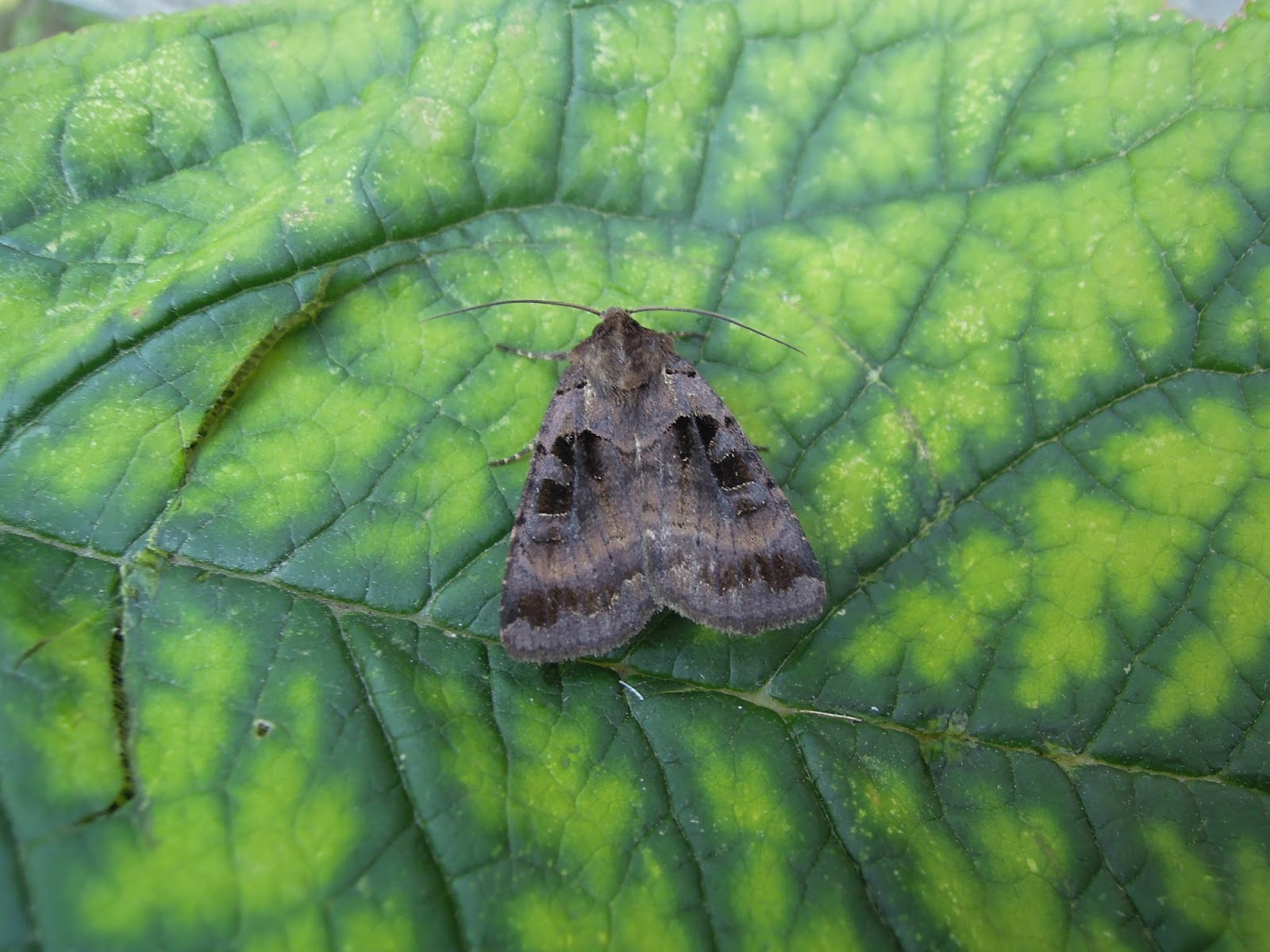
Mouse Moth Amphipyra tragopogonis
While the smart Carcina quercana occurs annually in small numbers and for some reason I haven't posted a photo before:

Carcina quercana

Monday, 7 August 2017

4th August 2017

I was lucky enough to receive a rather tasty MV trap for my birthday and this was the first opportunity of getting it out. First impressions were definitely favourable with the number and range of moths seeming pretty good considering that it wasn't optimal weather conditions. 

Eight were new for the garden, with of two of these being 'Cottenham lifers' - so a good night:


[364] Beautiful Plume

[365] Aethes smeathmanniana
[366] Acleris laterana
[367] Rhyaconia pinicolana
[368] Agriphila straminella
[369] Plain Pug
[370] Barred Rivulet
[371]Square-spotted Clay

This all means that I have now recorded over 100 new species in this second year of trapping compared to last year. The first completely new species was Barred Rivulet and in fact there were at least two individuals (another probable got away) - this is a species of chalk soils so perhaps its no surprise that I haven't seen it before. 


Barred Rivulet Perizoma bifaciata

Barred Rivulet Perizoma bifaciata - second individual
A. smeathmanniana was the other totally new one and the third species of Aethes recorded this year:


Aethes smeathmanniana

After the above two, Square-spotted Clay was the undoubted highlight. A very smart moth which is nationally scarce and only the second time I've picked one up in Cottenham:


Square-spotted Clay Xestia stigmatica

Rhyaconia pinocolana is a smart tortrix and recorded very infrequently here my me (just two records in 2013):


Rhyaconia pinicolana

Acleris laterana and comariana are a difficult species pair normally requiring dissection. Although I may report this eventually as the aggregate species, the time of capture and size of the moth points firmly to the former species:


Acleris laterana


Plain Pug is never a stunner but this one is even worse than normal:


Plain Pug Eupithecia simpliciata

Even less interesting than pugs perhaps are grass moths - I am surely guilty of totally overlooking A. straminella as its an abundant species. However, I looked at the small crambids this time around and they were all this species rather than C. culmella


Agriphila straminella

Just to get some colour in the post, here's a few good looking species:


Canary-shouldered Thorn Ennomos alniaria

Burnished Brass Diachrysia chrysitis
White-point Mythimna albipuncta


Friday, 21 July 2017

July 2017 - some common species

Here are some photos of common species that have been ignored in my previous posts:


Lesser Yellow Underwing Noctua comes


Bud Moth Splionota ocellana


Endotricha flammealis


Lesser Broad-bordered Yellow Underwing Noctua janthe

Shaded Broad-bar Scotopteryx chenopodiata


Dot Moth Melanchra persicariae


Agonopterix alstromeriana


Scalloped Oak Crocallis elinguaria


Fan-foot Herminia tarsipennalis


18th July 2017

The forecast predicted a heavy shower or two when in fact it rained continuously from around 11pm onwards - I decided to rescue the trap at 02:30 which wasn't too much fun. Happily, there were still some good moths left in the morning while one or two were potted before the deluge. There were  six additions to the garden including two not recorded in Cottenham before:

[358] Garden Rose Tortrix
[359] Catoptria pinella
[360] Pediasia contaminella
[361] Donacaula forficella
[362] Small Phoenix
[363] Twin-spotted Wainscot


Pediasia contaminella was the first completely new one for me, its distinctive resting posture giving it away:

Pediasia contaminella
Small Phoenix is one thats avoided my trap until now:

Small Phoenix Ecliptopera silaceata
There were three Twin-spotted Wainscots all looking subtedly different to each other. I think I recorded this species only twice at Corbett Street:

Twin-spotted Wainscot Lenisa geminipuncta
The Donacala forficella was a disnctive male and quite an interesting moth:

Donacaula forficella
I was somewhat shocked to find that Garden Rose Tortrix was new for the garden; its normally a common species with an extensive flight season. Not sure why it went missing last year:

Garden Rose Tortrix Acleris variegana
Scorched Carpet seems to be getting to be getting a little more regular here - this is the 3rd in 2 years after only being recorded once in the previous 6:

Scorched Carpet Ligdia adustata

Tuesday, 18 July 2017

13/15th July 2017

A nice bunch of  moths included eight new for the garden, of which three were totally new for me:

[349] Helcystogramma rufescens

[350] Argyotaenia ljungiana
[351] Eucosma obumbratana
[352] European Corn-borer
[353] Maple Pug
[354] Bordered Pug
[355] Dark Umber
[356] Phoenix
[357] Southern Wainscot


Helcystogramma rufescens is a fairly distinctive gelechid and quickly identified once I had bothered looking properly at it. I've not recorded this in Cottenham before:


Helcystogramma rufescens
Argyotaenia ljungiana is a moth that is rather inconsistent in appearance at my Cottenham traps. In some years it is common and in others completely absent (like last year). I do wonder sometimes if I'm overlooking it due to the unusually low standard illustration in Waring but I'm sure that is not the case - its reasonably distinctive:


Argyotaenia ljungiana

Eucosma obumbratana is a relatively local tortrix and the first I've recorded:


Eucosma obumbratana
The final micro caused me a headache but turned out to be a worn European Corn-borer:


European Corn-borer Ostrinia nubilialis
On to a tale of two pugs - one distinctive and one not so. The latter has caused some split opinions but looks a very strong candidate for Maple Pug. Bordered Pug otherwise is quite smart and recorded most years in Cottenham:


Bordered Pug Eupithecia succenturiata

Maple Pug Eupithecia inturbata
Dark Umber is a less than stunning moth (marginally better than the awful Brown Scallop!) but rare here - this my only record in the village since two in July 2013:


Dark Umber Philereme transversata
Southern Wainscot has a distinctive feature - a grey 'alice band' on the forehead. It not as obvious on this individual as others I've recorded but it is there.....


Southern Wainscot Mythimna straminea
I had completely overlooked that Phoenix is new for the garden (it was recorded annually at Corbett Street), so I didn't take too much care in getting a photograph;
Phoenix Eulithis prunata


New for the year moths included my second ever Webb's Wainscot:


Webb's Wainscot Globia sparganii
..and a Timothy Tortrix...

Timothy Tortrix Aphelia paleana


Tuesday, 11 July 2017

7th July 2017

Back home to Cambridgeshire to continued warm nights and it was rather busy with moths in the garden - just one short of the magic 100 species and so being the most diverse trapping night here to date. There was no big headliner like recent good nights but an excellent thirteen were new for the garden. Oak Nycteoline (of the attractive form ramosana) would have been the highlight but it made its escape without being photographed:

[335] Orchard Ermine
[336] Bucculatrix nigricomella
[337] Agonopterix subpropinquella
[338] Ypsolopha scabrella 
[339] Aethes rubigana
[340] Hedya salicella
[341] Celypha striana
[342] Cydia splendana
[343] Meal Moth
[344] Small Rivulet
[345] Haworth's Pug
[346] Wormwood Pug
[347] Brown-tail
[348] Oak Nycteoline


The Yponomeuta ermines are rather tricky indeed and a lot of what I see do not get assigned to species. However, this individual has a complete grey cast and therefore is a strong candidate for Orchard Ermine:


Orchard Ermine Yponomeuta padella

Contrast this to the plain white (including the cilia) of this Spindle Ermine:

Spindle Ermine Yponomeuta cagnagella
and the common and finer-spotted Bird-cherry Ermine:


Bird-cherry Ermine Yponomeuta evonymella
Bucculatrix nigricomella is a tiny micro and caused me a headache the first (and only) time I've recorded it as its not illustrated in Sterling & Parsons. It is reasonably distinctive however so I recognised it pretty quickly this time:


Bucculatrix nigricomella

The second species of Aethes seen here in the last month was this rubigana - only the second time I've seen it I think:


Aethes rubigana

The three new tortrixes (tortrices?) were all fairly common species but all missing last year


Hedya salicella

Celypha striana

Cydia splendana
Haworth's Pug however is far from common and thank god for the orange abdomen which makes it fairly distinctive for a pug:


Haworth's Pug Eupithecia haworthiata

I flipped with the identification of this pug between Wormwood and Currant before settling on the former - principally due to wing shape and size:


Wormwood Pug Eupithecia absinthiata
Small Rivulet is a moth I've recorded in Cottenham only once before I believe:


Small Rivulet Perizoma alchemillata


New for the year moths included this nice Anania coronata....


Anania coronata
and there were several of the tiny Horse Chestnut Leaf-miners


Horse Chestnut Leaf-miner Cameraria ohridella